
This guide is for judicial candidates and the people who run their campaigns. It applies to races for any court: a municipal or magistrate seat, a county or district trial court, an appellate court, or a state supreme court, including retention elections.
Judicial campaigns differ from other races in two ways. A code of judicial conduct limits what the candidate, and anyone working on the campaign, can say in an ad. And many voters reach the judicial races on their ballot knowing little about the candidates. The first half of this guide covers the rules. The second half covers how to plan media around them.
This is a practical summary, not legal advice. Each state has its own code of judicial conduct, and about 45 states have a judicial ethics advisory committee that answers questions from judges and candidates. Read your state's code, and ask its committee when you're unsure, before ads go into production.
Know What Kind of Election You're In
In 39 states, voters elect at least some trial or appellate judges, and in 38 states the justices of the highest court run in contested or retention elections. A state can use different methods for different courts, so start by confirming how your seat is filled.
- Partisan elections put party labels on the ballot, so the party label and party endorsements can carry much of the message.
- Nonpartisan elections leave party labels off the ballot. Voters have less to go on, which puts more weight on name recognition and credentials, and state codes limit how candidates can use party support.
- Retention elections ask voters whether to keep a sitting judge. There's no opponent on the ballot, so the campaign is about name recognition and a reason to vote yes.
The level of the court matters as much as the type of election. A municipal or magistrate seat may be elected by a single town or city. A trial court seat may cover a county or a multi-county district. Appellate and supreme court seats are often elected statewide or from large regions. That geography decides which channels make sense, and the planning section below goes through it court by court.
What Your Ads Can Say
Every state has a code of judicial conduct, and the codes are substantially similar because each one is based on the ABA Model Code of Judicial Conduct. The campaign rules are in Canon 4, and they apply to sitting judges and first-time candidates alike. This section follows the Model Code. Your state's version may number or word the rules differently.
Two of those rules shape how a campaign works with consultants. The candidate has to take reasonable measures to make sure no one acting on the candidate's behalf, including the campaign committee and the agency making the ads, does anything the candidate is prohibited from doing (Rule 4.1). The exception is fundraising, which the code allows the committee to do on the candidate's behalf. And under Rule 4.2, the candidate has to review and approve the content of all campaign statements and materials before they go out. Build that approval step into the production schedule.
Your committee asks for money, not you
The Model Code bars judicial candidates from personally soliciting campaign contributions. A campaign committee raises the money instead. The Supreme Court upheld that kind of rule in Williams-Yulee v. Florida Bar (2015), noting that 30 of the 39 states that elect trial or appellate judges had adopted similar restrictions.
In practice, donation asks in ads, emails, texts, and on the donate page should come from the committee. Whether the candidate can sign a fundraising letter varies by state, so check before sending one. Some states also limit when fundraising can start. Indiana's code, for example, lets a candidate form a committee and accept contributions no earlier than one year before the primary or general election.
Share your views, but don't promise rulings
Since Republican Party of Minnesota v. White (2002), judicial candidates can announce their views on disputed legal and political issues. What the Model Code still prohibits are pledges, promises, or commitments about cases, controversies, or issues likely to come before the court that are inconsistent with impartially performing the duties of the office (Rule 4.1). The commentary adds that a pledge doesn't depend on any particular words, so rephrasing a promise doesn't make it acceptable.
Ordinary campaign language is full of promises, so this rule needs the most care when writing scripts. A line like "I'll keep repeat offenders behind bars" commits the candidate to an outcome in a category of cases. A line about the candidate's years in practice, the kinds of cases they've handled, and how they treat the people who appear before them describes qualifications without promising a result.
Be accurate about yourself and your opponent
The Model Code prohibits making any false or misleading statement knowingly or with reckless disregard for the truth (Rule 4.1). In ads, watch titles closely: describe the office accurately, and don't imply that a candidate who isn't a judge already holds the seat.
If an opponent or an outside group makes false or misleading claims about you, the commentary allows a factually accurate public response, as long as the response follows the other campaign rules.
Keep court resources out of the campaign
Judges and judicial candidates can't use court staff, facilities, or other court resources in a campaign (Rule 4.1). For an incumbent, that rules out using court staff for campaign work, and it can rule out filming in a courtroom or chambers. Ask your state's advisory committee before planning a shoot at the courthouse.
Endorsements and party ties
The Model Code generally bars judges and judicial candidates from publicly endorsing or opposing candidates for other offices (Rule 4.1). Rule 4.2 then sets out what candidates in public elections may do, and states write their own versions. Indiana's, for example, lets candidates in partisan races identify as a party's candidate and seek party endorsements, and lets candidates in nonpartisan races seek endorsements from people and groups other than political organizations. It also lets candidates in partisan judicial races endorse other candidates running in the same election cycle, which the Model Code generally prohibits.
Broadcast and Ad Platform Rules
Broadcast TV and radio
Federal rules require broadcast stations to sell airtime to legally qualified candidates for any public office at the station's lowest unit charge during the 45 days before a primary and the 60 days before a general election. Judicial candidates qualify once they've publicly announced and meet the other requirements in the FCC's definition.
Two details matter for planning. The rate applies to a candidate's "use" of the station, which the FCC defines as an appearance by the candidate's voice or picture, so the candidate needs to appear in the ad. And it applies to candidates, so a PAC or independent group supporting a judicial candidate doesn't get the lowest unit charge.
Meta
Meta requires authorization for ads made by, on behalf of, or about a candidate for public office, and those ads must carry a "Paid for by" disclaimer. The policy doesn't exclude judicial candidates, so plan on authorizing the committee's ad account well before launch.
Google and YouTube
Google's US election ads policy names federal offices, state-level offices such as governor and state legislator, political parties, and state ballot measures. It doesn't mention judicial seats. Ask Google how your race will be treated before launch, and include a paid-for-by disclaimer either way.
Your state's election law may also set the wording of the paid-for-by line on every ad, and the Model Code requires judicial candidates to comply with election laws (Rule 4.2).
Reaching Voters at Every Level
In most judicial races, the first job is getting voters to notice the race at all. Many people who vote skip the judicial contests further down the ballot, a pattern political scientists call roll-off. Every plan needs ads that tell supporters the race is on the ballot and help them recognize the candidate's name when they see it.
What the ads should say
Because the rules limit promises, credentials carry the message. We build judicial ads around the candidate's name, the office, and one clear qualification, such as years in practice, the kinds of cases the candidate has handled, or prior service on the bench. Endorsements and bar association ratings help too, where your state's code allows them and the ratings are published.
Municipal, magistrate, and other local courts
These seats are elected by a single city, town, or county, and the electorate is often small, especially in an odd-year or primary election. Broadcast TV reaches far more people than can vote in the race, so the budget goes further on channels matched to the voter file: social and digital ads aimed at likely voters, a few mail pieces to older, high-turnout households, and printed materials for door-to-door and community events. A campaign website gives every ad and mailer somewhere to send people.
County and district trial courts
A countywide or multi-county trial court race covers more voters and usually has a bigger budget. Streaming ads matched to the voter file put a video ad on the television screen without paying for the whole TV market, and cable can often be bought by zone. Our CTV/OTT guide explains the targeting. Broadcast makes sense when the district makes up most of a TV market. Digital and mail can then put more of the budget into the parts of the district where the race will be decided.
Appellate and supreme courts
Statewide and large regional races are where broadcast TV usually makes sense, alongside streaming and digital. They're also where outside spending is heaviest. The 2025 Wisconsin Supreme Court race became the most expensive judicial race in American history, according to the Brennan Center for Justice. Ads from independent groups are outside the campaign's control, so decide early how the campaign will respond to an attack. A response that is factually accurate is allowed, and setting aside budget for one means it can run quickly.
Retention elections
A retention campaign asks for a yes vote, with no opponent on the ballot. Many voters know little about the judge, so the work is awareness and a simple reason to vote yes: experience, a record on the bench, and any endorsements the code allows. If an organized campaign against retention appears, the race starts to look like a contested one, and the response planning above applies.
A Planning Timeline
- Read your state's code and find its advisory committee.
- Form the campaign committee and confirm when it can start raising money.
- Set up ad accounts and start platform authorization with Meta and Google well before launch.
- Agree on an approval process. The candidate has to review and approve every ad, so schedule time for it in each production cycle.
- Reserve broadcast time early if broadcast is in the plan, and know when the lowest unit charge windows open: 45 days before the primary and 60 days before the general election.
- Land the main message before early voting. Many voters cast ballots early or by mail, so persuasion should run before early voting begins, with reminders through Election Day.
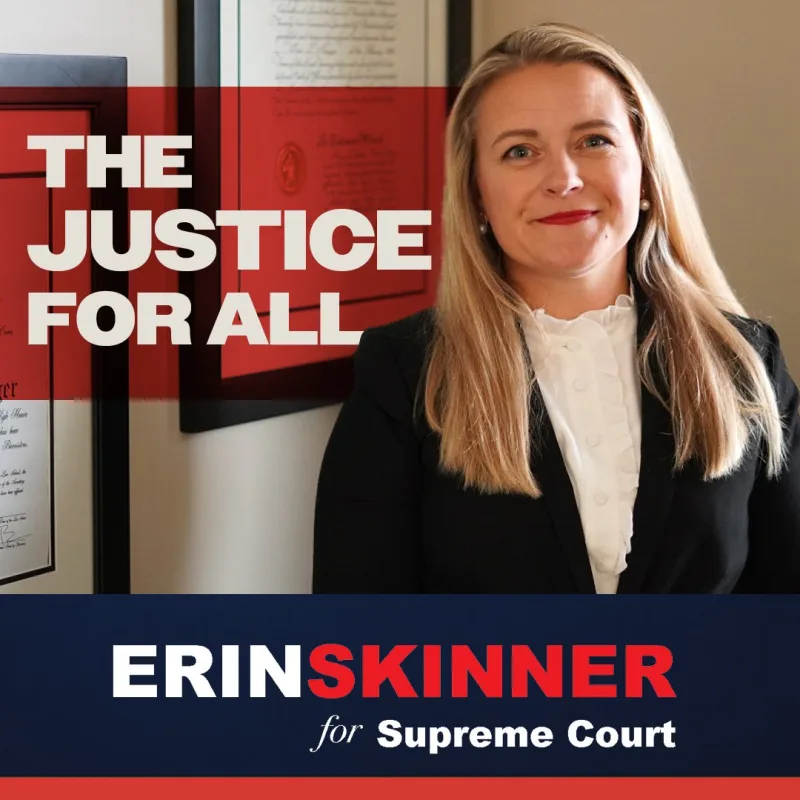
Example: Erin Skinner's Supreme Court Race
In New York, the Supreme Court is the state's main trial court, and its justices serve 14-year terms. In 2024, four candidates ran for two open seats in the 7th Judicial District, which covers eight counties. Erin Skinner, a Democrat, wasn't a sitting judge. She was a law clerk to an Appellate Division justice, had clerked at the state's highest court, and had worked as an assistant public defender (WXXI News).
She ran as the underdog. On election night a Republican led the field, and Skinner held the second seat by about 2,000 votes over another Republican (WXXI News). She was declared the winner in December with no recount needed (Finger Lakes Daily News).
We ran her paid media. The ad below shows two points from this guide: her name and the office are the largest elements, and it says "for Supreme Court" rather than giving her a title she didn't hold yet.
How We Work With Judicial Campaigns
We plan and buy media for judicial candidates and create the ads, and we check every script against the state's code before it goes to the candidate for approval. We've worked with judicial candidates from town and city courts up to New York State Supreme Court. See our clients for the full list.
Frequently Asked Questions
Sources
- American Bar Association, Model Code of Judicial Conduct, Canon 4 (Rules 4.1 and 4.2): campaign conduct rules for judges and judicial candidates. americanbar.org
- Williams-Yulee v. Florida Bar, 575 U.S. 433 (2015): the ban on personal solicitation, and the count of states that elect judges. law.cornell.edu
- Republican Party of Minnesota v. White, 536 U.S. 765 (2002): candidates' right to announce views on disputed issues. justia.com
- Charles Gardner Geyh, State Court Report (December 14, 2023): state codes of judicial conduct and the ABA model. statecourtreport.org
- Cynthia Gray, Court Review (2018): judicial ethics advisory committees in the states. digitalcommons.unl.edu
- MultiState (June 26, 2024): how states elect their highest court. multistate.us
- Indiana Code of Judicial Conduct, Rule 4.2: an example of state variations on the Model Code. incourts.gov
- 47 CFR 73.1940, 73.1941, and 73.1942: FCC rules on legally qualified candidates, candidate "uses," and lowest unit charge. law.cornell.edu
- Meta, ads about social issues, elections or politics: authorization and disclaimer requirements. transparency.meta.com
- Google Ads, political content policy: election ads verification in the US. support.google.com
- Herbert M. Kritzer, Journal of Law and Courts: roll-off in state court elections. cambridge.org
- WXXI News (November 6, 2024): election-night results in the 7th Judicial District Supreme Court race, and Erin Skinner's background. wxxinews.org
- Finger Lakes Daily News (December 2024): Skinner declared the winner with no recount needed. fingerlakesdailynews.com
- Brennan Center for Justice (March 24, 2025): spending in the 2025 Wisconsin Supreme Court race. brennancenter.org